Views: 0 Author: Site Editor Publish Time: 2026-07-25 Origin: Site
Integrating high-power thermal technologies into food manufacturing presents a high-stakes balancing act. Facilities must meet aggressive throughput goals while maintaining rigid safety and hygiene mandates. We see this challenge across modern production lines daily. Non-compliant systems cause immense operational friction. They result in failed facility audits, worker safety liabilities, and inconsistent product kill-steps. You simply cannot afford these disruptions. Substandard machinery exposes operators to harmful emissions and compromises food safety. We built this guide to tackle these challenges head-on. Our goal is to provide operations and quality assurance leaders with a practical framework. You will learn how to evaluate vendors effectively. We will show you how to mitigate regulatory risks before signing any capital procurement contracts. Armed with this knowledge, you can confidently integrate advanced thermal solutions.
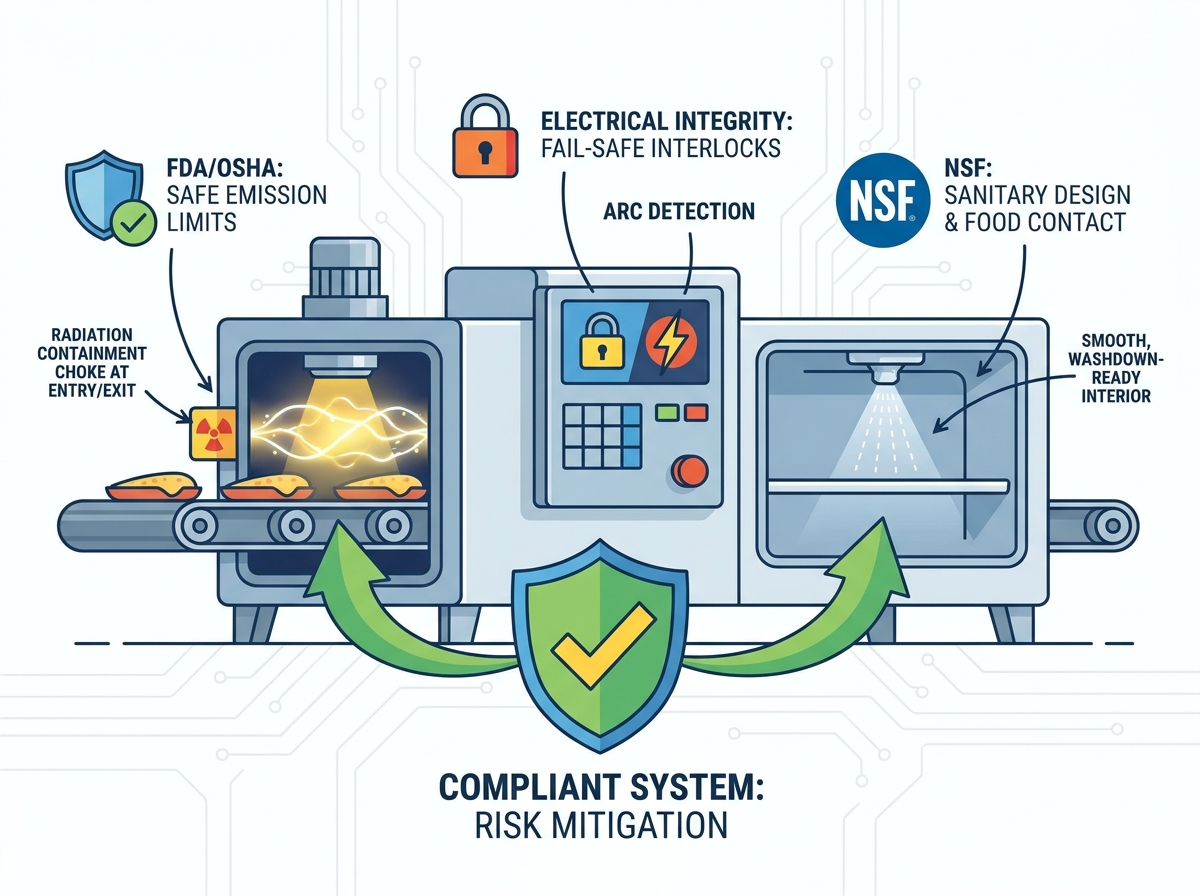
Evaluating industrial microwave systems requires verifying compliance across three distinct vectors: emission safety (FDA/OSHA), food contact hygiene (NSF), and electrical integrity.
Reliable vendor evaluation demands documented proof of redundant safety mechanisms, such as multi-layer choke designs and fail-safe interlock systems.
Implementation success hinges on post-installation field testing and rigorous Standard Operating Procedures (SOPs) for continuous monitoring.
Procurement shortlists should prioritize manufacturers offering transparent Factory Acceptance Testing (FAT) and comprehensive compliance documentation.
Prioritizing certified systems substantially reduces your long-term operational risks. By investing in compliant machinery upfront, you experience fewer insurance claims. You protect your workforce from hazardous exposure incidents. Furthermore, you drastically cut down on expensive audit downtime. We must look beyond initial purchase prices during procurement. A cheaper, non-compliant machine ultimately drains resources through constant safety interventions. Proper compliance shields your brand reputation. It guarantees uninterrupted production cycles. You insulate your facility against sudden regulatory fines. We consider compliance an active profit-protection strategy.
Retrofitting non-compliant equipment to meet sanitary standards rarely succeeds. It is economically unviable compared to procuring compliant-by-design systems. Modifying an existing machine requires complex engineering adjustments. It often voids manufacturer warranties. You suffer prolonged line shutdowns during these modifications. Custom fabrication for hygienic upgrades costs exponentially more than factory-integrated solutions. The core geometry of a machine dictates its field distribution. Altering access panels or conveyor seals disrupts this delicate balance. You risk creating new radiation leakage points. We always advise against post-market safety retrofits for industrial thermal units.
You must redefine how you measure procurement success. Heating uniformity matters. Throughput speeds remain important. However, true success relies on verifiable adherence to recognized industrial standards. We evaluate success using the following metrics:
Seamless integration into existing Hazard Analysis Critical Control Point (HACCP) plans.
Zero required modifications to meet local sanitation codes.
Immediate approval from third-party safety inspectors.
Operator confidence backed by intuitive safety controls.
Federal regulators enforce strict limitations on radiation emissions. These rules protect workers in industrial operational environments. The FDA mandates specific milliwatt per square centimeter limits. New equipment must not exceed 1 mW/cm² at any point 5 centimeters from external surfaces. Over the machine's lifetime, this limit expands slightly to 5 mW/cm². You must enforce these boundaries strictly. Routine mapping ensures your Microwave Heating Equipment remains compliant. We use calibrated survey meters to track these metrics continuously. Failing to maintain these limits triggers immediate operational shutdowns.
Food contact zones require meticulous engineering. NSF standards dictate clean-in-place (CIP) compatibility. Hygienic welding is absolutely non-negotiable. Manufacturers must use approved food-grade stainless steel. We look for continuous, smooth welds ground flush with the base metal. Equipment must avoid overlapping joints. These standards apply equally to direct and indirect food contact areas. Even condensation drip pans must meet hygienic guidelines. You cannot overlook airborne contamination risks inside the heating cavity.
Federal workplace safety mandates dictate rigorous equipment shielding. OSHA requires comprehensive lockout/tagout (LOTO) integration. Maintenance personnel must safely isolate the power supply before servicing the magnetron. Warning label placement requires strategic planning. You must position high-voltage and radiation warning signs at eye level. They must sit clearly on all removable access panels. We ensure all safety directives integrate seamlessly into daily operations. Confusing safety protocols inevitably lead to fatal operator errors.
Commercial insurers evaluate your equipment rigorously. Companies utilizing Hanover risk guidelines look specifically at fire suppression. They assess your thermal runaway safeguards closely. Magnetrons generate immense heat. Product jams inside the cavity can quickly ignite. Insurers demand automated suppression systems. They look for sensors capable of detecting smoke or rapid temperature spikes. Meeting these underwriting requirements lowers your commercial insurance premiums. It guarantees coverage during catastrophic facility events.
This table outlines the primary focus areas for major regulatory bodies governing thermal processing units.
Regulatory Body | Primary Focus Area | Core Requirements & Metrics |
|---|---|---|
FDA / CDRH | Emission Limits | Maximum 5 mW/cm² leakage at 5cm distance during lifetime operation. |
NSF International | Sanitary Design | CIP compatibility, 304/316 stainless steel, no dead legs or crevices. |
OSHA | Worker Protection | LOTO integration, safety relay circuits, mandatory hazard labeling. |
NFPA | Fire Suppression | Automated arc detection, integrated cavity suppression nozzles. |
You must evaluate a vendor’s proprietary choke designs carefully. These mechanisms prevent energy leakage at continuous feed entry and exit points. Manufacturers utilize corrugated, pin, or reactive chokes. Each design tackles specific wavelength challenges. Quarter-wave chokes suppress stray fields mechanically without physical contact. This allows food products to pass freely. Pin chokes handle highly variable product loads efficiently. We recommend demanding extensive testing data for these chokes. Poor choke design remains the leading cause of emission compliance failures.
Access doors require redundant protection. You need mechanically and electrically isolated interlock switches. These guarantee instant power termination upon unauthorized entry. We specify Category 4 safety relays for all industrial units. If an operator opens a cavity door, the magnetron must lose power immediately. The system must prevent automatic restarts when the door closes. Single-switch systems fail frequently. They succumb to mechanical wear or purposeful operator bypass. True compliance requires tamper-proof, redundant safety loops.
Plasma arcing presents a severe fire hazard. Built-in sensors must detect these ultraviolet light flashes instantly. Once detected, the system must immediately decouple the magnetron power. This stops the arc from sustaining itself. The machine must also interface with your facility fire suppression networks. We look for systems injecting steam or inert gas directly into the cavity. Active suppression prevents localized fires from spreading into your main exhaust ductwork. Relying solely on external sprinklers violates basic safety protocols.
Evaluating sanitation design demands a critical eye. You must verify the ease of access for swab testing. Equipment architecture must eliminate harborage points completely. Dead legs trap bacteria. Flat horizontal surfaces gather dust and moisture. We specify sloped surfaces for all external housing. Washdown environments require IP65 or IP69K rated enclosures. These protect sensitive electronics from high-pressure hot water jets. Adhering to strict Standards for Industrial Microwave Equipment guarantees long-term hygiene success. If a cleaning crew cannot access a corner, bacteria will thrive there.
You must translate theoretical standards into localized site acceptance testing (SAT). Factory conditions differ wildly from your plant floor. Once installed, technicians utilize calibrated survey meters. They map the emission profiles comprehensively. They check every door seal, choke tunnel, and waveguide joint. You document this baseline data meticulously. It serves as your primary reference point for all future audits. Skipping baseline verification exposes you to immense legal liability. We consider a machine incomplete until it passes a localized SAT.
Establishing required maintenance frequencies ensures ongoing safety. You cannot adopt a "run-to-failure" mentality here. Implement these specific protocols:
Daily visual inspections: Check door seals for physical damage or accumulated food debris.
Weekly functional tests: Actuate every interlock switch physically to confirm power termination.
Monthly emission surveys: Use calibrated meters to scan all choke entry and exit points.
Quarterly magnetron analysis: Monitor the lifecycle and output efficiency of the primary heating tubes.
Following this structured list prevents catastrophic equipment failures.
Your operators form the strongest defense against safety breaches. They require rigorous training on thermal technology. They must recognize containment faults immediately. A sudden change in machine hum often indicates arcing. Operators must respond to thermal alarms without hesitation. Standard Operating Procedures (SOPs) require clear, accessible language. Maintain perfect documentation for external audits. When an OSHA inspector arrives, they check your training logs first. Poorly trained staff negate even the best engineering controls.
Filter out vendors who rely solely on self-certification. You need verifiable certifications from recognized testing laboratories. Organizations like UL, CE, or NSF provide objective validation. Self-certified equipment often fails independent audits later. We demand certificates showing the exact model number under consideration. Do not accept generic company-wide quality certificates. You are buying a specific machine. That specific machine requires verified third-party testing. If a vendor hesitates to provide these documents, remove them from your shortlist immediately.
Insist on transparent Factory Acceptance Testing before the equipment ships. You should demand live video feeds or comprehensive documented reports. The FAT must demonstrate full emission containment. It must prove the safety loop functionality under simulated load conditions. We bring our own sample products to these tests. We try to force the machine to fail. If the interlocks function correctly, the machine passes. Never accept a machine based on blueprint promises alone. FAT transparency reveals the true build quality.
Comprehensive manuals safeguard your operational continuity. Require complete electrical schematics before signing the final invoice. Your maintenance team cannot troubleshoot proprietary black boxes. Demand precise sanitation guidelines tailored to the machine's geometry. Certified emission reports satisfy both QA and safety teams. You need detailed spare parts lists with exact specifications. We consider incomplete documentation a breach of contract. A high-quality vendor provides digital and physical copies of all technical literature.
Evaluate the vendor’s capability to provide localized field service. An excellent machine becomes a liability if you cannot repair it quickly. You need partners who offer rapid re-calibration services. They must guarantee access to genuine replacement parts. Assess their average response times for emergency dispatches. Can they supply a replacement magnetron within 24 hours? We audit a vendor's service network as rigorously as their engineering. Long-term compliance relies entirely on capable post-sale support.
Purchasing industrial microwave systems represents a critical exercise in risk management and compliance verification.
Partnering with OEMs who embed strict standards into their core architecture protects your brand reputation and operational continuity.
Avoid retrofitting strategies; always procure compliant-by-design systems to eliminate costly production downtime.
Consult with your internal safety officers today and request detailed compliance packets from every shortlisted vendor.
A: The FDA mandates a strict leakage limit for industrial systems. New equipment must not exceed 1 mW/cm² at 5 centimeters from the surface prior to shipment. During operational field testing over its lifetime, the maximum allowable leakage is 5 mW/cm². Routine localized testing ensures these limits hold under daily production stress.
A: Facilities should perform baseline emission surveys monthly using calibrated meters. Additionally, trigger events require immediate surveying. You must map the machine after any door seal replacement, choke tunnel modification, or magnetron repair. Daily visual checks of seals and weekly interlock tests should supplement these instrumental surveys.
A: Modifying standard equipment to meet NSF standards is highly discouraged. Post-market sanitary retrofits have a high failure rate. Achieving proper hygienic welding and eliminating crevices alters the machine's geometry. This disrupts the engineered microwave field, causing irregular heating and potential radiation leaks. You should procure sanitary-designed systems initially.
A: Auditors routinely request your specific Standard Operating Procedures (SOPs) for the equipment. They examine daily maintenance and cleaning logs. You must provide initial Factory Acceptance Testing (FAT) and Site Acceptance Testing (SAT) reports. Finally, they require recent calibration certificates for the survey meters used during your routine emission checks.