Views: 0 Author: Site Editor Publish Time: 2026-07-31 Origin: Site
High-volume food production requires balancing rapid throughput, strict food safety compliance, and healthy operational margins. Traditional thermal systems often create severe bottlenecks at scale. When demand peaks, relying on legacy commercial ovens slows down the entire assembly line.
For central kitchens and fast-food commissaries, adopting industrial-grade thermal solutions represents a critical capital expenditure decision. This single choice strictly dictates your facility's daily production capacity. It also impacts long-term product consistency across multiple franchise locations. Relying on outdated machinery stifles growth and limits menu expansion.
We will explore how modern systems fundamentally outperform older technology in high-stress food processing environments. This guide breaks down how to evaluate high-capacity systems against complex operational realities and stringent safety standards. You will learn how to navigate equipment capabilities, avoid common implementation risks, and update your standard operating procedures safely.
Speed vs. Uniformity: Industrial microwave systems reduce heating times by up to 70% compared to conventional methods while maintaining core temperature consistency.
Compliance is Non-Negotiable: Any system chosen must reliably meet USDA/FSIS safe handling and hot-holding temperature thresholds without manual intervention.
Total Cost of Ownership (TCO): While the initial CapEx for advanced microwave systems is higher, the ROI is justified through reduced energy consumption, smaller facility footprint, and lowered labor costs.
Integration Risks: Successful deployment requires facility electrical upgrades and rigorous updates to standard operating procedures (SOPs).
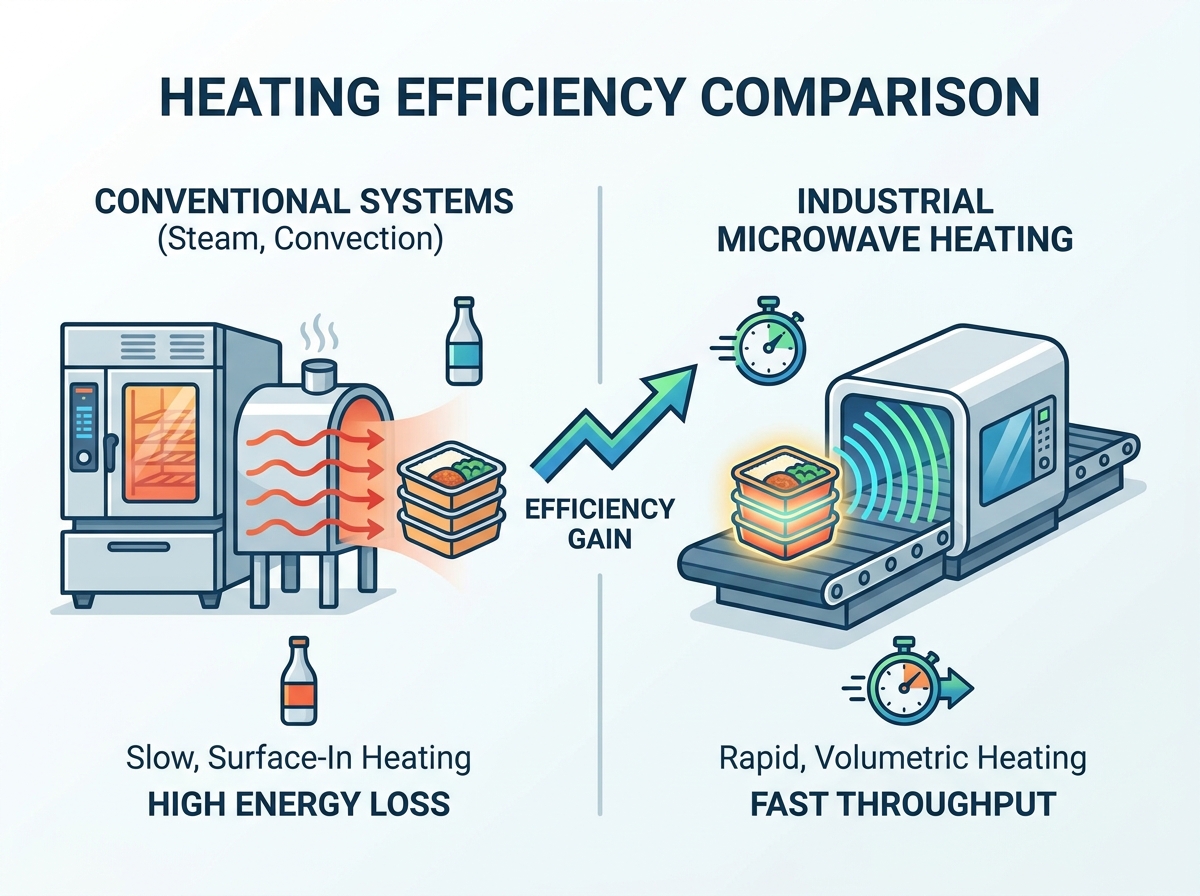
Fast food operations rely on predictable speed. Legacy cooking methods consistently struggle to keep pace during peak demand. The primary issue stems from poor thermal transfer dynamics. When you stack densely packed boxed meals on a continuous conveyor, heat penetration slows down significantly.
Steam tunnels and convection ovens heat the exterior of a product first. The thermal energy slowly conducts toward the center. This mechanism creates a massive time delay in rapid assembly lines. Facility managers frequently spot conveyor belts backing up because workers must wait for dense meals to reach safe internal temperatures.
Energy inefficiency compounds this throughput challenge. Traditional commercial kitchens suffer from severe ambient heat loss. Convection and steam systems require constant energy draw to maintain operating conditions. Much of this expensive energy escapes into the facility atmosphere. Your HVAC systems must then work overtime to cool the ambient environment. This cycle wastes massive amounts of electricity and gas daily.
Furthermore, cold spots create severe compliance friction. The USDA mandates strict safe handling standards. If central kitchens fail to hit hot-holding thresholds uniformly, they risk dangerous food safety violations. Uneven thermal transfer also degrades food texture. Overcooking the outer layers to reach internal target temperatures ruins the overall product quality. Boxed meals emerge dry on the outside and barely warm on the inside.
Choosing the right thermal technology defines your entire processing layout. We must objectively compare modern innovations against traditional workhorses. For high-volume environments, adopting Microwave Heating Equipment alters the entire production timeline.
Modern industrial microwaves utilize volumetric heating. They heat the product from within by agitating water molecules simultaneously throughout the food mass. This mechanism maximizes processing speed.
Best for: High-throughput continuous processing, rapid tempering, and boxed meal assembly lines.
Limitations: Higher initial capital expenditure. They require precise moisture control in recipes to prevent over-processing.
These legacy systems rely on forced hot air circulation. High-velocity fans blow heated air across the food surface to accelerate cooking.
Best for: Surface crisping, traditional baking, and browning applications.
Limitations: Slower core heating for dense packaged meals. They generate high ambient heat waste and consume massive amounts of floor space.
Steam systems utilize high-moisture thermal transfer. They envelop the product in pressurized steam to raise internal temperatures gradually.
Best for: Retort packaging and general moisture retention.
Limitations: Extremely large equipment footprint. They dictate much slower processing times and drive high water utility consumption.
Below is a direct comparison to clarify operational differences.
Technology Type | Primary Mechanism | Heating Speed | Ambient Heat Waste | Footprint Efficiency |
|---|---|---|---|---|
Industrial Microwave | Volumetric / Internal | Extremely Fast | Minimal | High |
Convection Ovens | Forced Air / Surface | Moderate | High | Low |
Steam Tunnels | Moisture / Conduction | Slow | Moderate | Moderate |
Replacing legacy equipment requires objective data analysis. Facility managers must look beyond top-level marketing claims. Evaluating industrial thermal systems means analyzing exact production metrics.
Throughput and scalability stand as your primary evaluation metrics. You must calculate the pounds-per-hour processing capacity directly against available floor space. Expanding physical facility footprint often proves impossible. The goal is packing maximum production volume into a minimal square footage area. High-density processing lines depend entirely on rapid turnover rates.
Next, carefully analyze energy utilization. Guaranteeing Efficient Heating requires benchmarking kilowatt-hour consumption per unit produced. Modern systems convert over 85% of drawn energy directly into the food product. Legacy systems lose a massive percentage of energy to the surrounding air. Tracking pure utility consumption per meal reveals the true operational efficiency of your chosen machinery.
Finally, you must rigorously audit compliance and validation features. Meeting USDA and FDA regulations is non-negotiable. Ensure your selected equipment features automated data-logging capabilities. Modern setups integrate HACCP compliance tracking directly into their software. Automated temperature validation removes human error from the equation. It guarantees safe handling standards are met continuously during every production shift.
Deploying advanced technology introduces new operational challenges. Transitioning from legacy ovens to volumetric heating requires strategic facility planning.
Facility infrastructure requirements dictate your initial timeline. You must audit electrical load capacities before making any purchase. Industrial magnetrons draw significant power and require specialized cooling requirements. Many older commissaries lack the necessary electrical infrastructure. Planners must map out spatial workflows to integrate new conveyors smoothly.
Standardizing workflows becomes an immediate priority. Integrating new digital technology requires completely updating your standard operating procedures. You cannot use old manual checklists for automated machinery.
Update Operator Checklists: Remove visual-cue cooking steps. Insert specific digital recipe input protocols.
Revise QA Testing Protocols: Establish new core-temperature probing routines based on faster line speeds.
Implement Cleaning Procedures: Document specific wipe-down techniques for waveguides and specialized belts.
Maintenance and downtime risks demand careful attention. Industrial systems utilize highly specialized replacement parts. Sourcing industrial magnetrons and waveguide components requires established supply chains. You must secure preventative maintenance contracts ahead of time. Waiting for parts to ship during an emergency breakdown halts entire production runs.
Staff training constraints also pose a significant hurdle. Moving away from legacy cooking fundamentally changes daily routines. Workers previously relied on visual cues like browning or bubbling. They must now interface directly with automated, recipe-driven digital touchscreens. Management must invest heavily in hands-on training to bridge this technological gap effectively.
Identifying the right manufacturing partner mitigates severe operational risks. You must approach vendors armed with specific facility data.
Start by defining your success metrics clearly. Document exact throughput requirements in pounds-per-hour. Specify your mandatory target temperatures. Measure your exact product dimensions, including packaging sizes. Having these numbers ready prevents vendors from quoting underpowered or oversized machinery.
The pilot testing phase is absolutely crucial. Buyers must demand a live facility test run before signing contracts. Use your exact boxed meal formulations during these tests. You need to verify even heat distribution and texture retention personally. Do not rely on generic demonstration videos. If the vendor cannot process your specific menu items successfully, look elsewhere.
Utilize a strict vendor evaluation checklist during negotiations. Ask direct questions regarding long-term reliability.
Do they offer seamless integration support for your existing conveyor systems?
What are their exact Service Level Agreements for emergency downtime response?
Do they stock specialized spare parts domestically to avoid international shipping delays?
Can they provide custom training modules for your specific shift operators?
Treat the equipment manufacturer as a long-term production partner. Their engineering support dictates how quickly you can resume full-scale operations after installation.
Upgrading to modern industrial thermal machinery shifts production from a labor-intensive bottleneck into a highly predictable process. Central kitchens can finally scale operations without proportionally increasing labor hours or facility footprint. Predictability breeds profitability in high-volume food processing environments.
Base your final purchasing decisions entirely on verifiable data. Rely on rigorous pilot test results and detailed energy audits. Do not make strategic moves based solely on top-level capacity claims found in marketing brochures. Dig deep into the operational realities of your daily workflow.
Take action immediately to resolve your facility bottlenecks. Request an engineering consultation or a dedicated product testing session with a qualified equipment manufacturer. Baseline your current production limits today. By mapping out your existing inefficiencies, you can seamlessly deploy advanced systems and secure your competitive edge.
A: No. Evidence shows volumetric heating often retains nutrients better than prolonged thermal processing. This retention occurs due to much shorter exposure times to heat. Furthermore, the lack of leaching—which frequently occurs during boiling or heavy steaming—preserves sensitive vitamins and minerals inside the food product effectively.
A: Depending on local energy costs and production volume shifts, ROI is typically realized within 18 to 36 months. This timeline is primarily driven by immediate labor optimization. You also gain significant savings by drastically reducing ambient energy waste compared to running legacy convection ovens continuously.
A: Standard systems cannot. However, specialized modified-atmosphere packaging (MAP) or specific engineered foils designed explicitly for industrial microwaves are required. Vendors must validate packaging compatibility thoroughly during the pilot phase to prevent arcing and ensure complete safety.
A: Modern systems utilize integrated Programmable Logic Controller networks paired with fiber-optic temperature sensors. These components drive automated data logging. They instantly record and verify precise HACCP compliance data without requiring manual human intervention on the assembly line.