Views: 0 Author: Site Editor Publish Time: 2026-07-07 Origin: Site
The ready-to-eat sector is scaling rapidly across the globe to meet shifting consumer demand. However, traditional thermal processing bottlenecks, such as slow steam tunnels and batch retorts, force processors into a difficult operational compromise. You frequently must sacrifice meal quality to guarantee high throughput and strict food safety. Conventional conduction heating creates severe thermal gradients inside packaged foods. It routinely causes severe edge-overheating while leaving dangerous cold-spots near the geometric center. This uneven energy transfer extends processing cycle times and heavily degrades the nutritional profile of delicate ingredients.
Transitioning to continuous Microwave Heating resolves these thermal gradients entirely. It offers a highly scalable, compliant, and energy-efficient alternative. In this article, you will discover how volumetric energy transfer transforms high-volume Pre-made Meal Processing operations. We will explore the exact mechanisms, evaluate the equipment dimensions, and outline the rollout realities you must navigate to achieve optimal quality, speed, and safety.
Volumetric Heat Delivery: Microwave systems heat from within, drastically reducing process times compared to conventional conduction/convection methods.
Quality Retention: Shorter thermal exposure minimizes the degradation of textures, flavors, and nutritional value in pre-made meals.
Footprint & Energy Efficiency: Advanced Microwave Heating Equipment requires a significantly smaller facility footprint and offers direct energy transfer, aligning with facility decarbonization (ESG) goals.
Implementation Reality: Success requires precise dielectric property mapping of food matrices, careful packaging selection, and rigorous thermal validation for regulatory compliance.
Continuous food production lines currently face a fundamental thermodynamic problem. Steam and hot water pasteurization systems rely entirely on slow thermal conduction. Heat must travel from the surrounding environment, pass through the packaging exterior, and eventually reach the product core. This physical limitation dictates the maximum speed of your entire processing line. You cannot accelerate conduction simply by turning up the heat without ruining the product.
Processors face a serious daily quality compromise. You must ensure the geometric center of a dense meal reaches specific lethality temperatures. To achieve pasteurization at the core, you routinely overcook the outer layers. Dense, multi-layered meals suffer the most damage during this process. Proteins dry out, starches turn gummy, and vegetables completely lose their structural integrity.
These long heating and cooling cycles create immense operational drag. Conventional thermal equipment requires massive physical footprints. Spiral ovens and long steam tunnels consume valuable factory floor space. They restrict overall facility throughput and create bottlenecks. Slower processing lines inherently increase your Work in Progress (WIP) inventory, trapping capital on the factory floor.
A successful technological upgrade must meet rigid success criteria. A viable alternative should reduce thermal cycle times by at least 40 percent. It must eliminate dangerous cold spots to ensure microbial safety. The solution should easily fit inside your current facility constraints. Finally, it must scale production without drastically spiking your daily utility costs.
Unlike slow conduction, electromagnetic waves penetrate the meal directly. The energy causes polar molecules, primarily water, to oscillate millions of times per second. This rapid dipole rotation creates immediate molecular friction. The friction generates rapid, uniform heat throughout the entire product mass simultaneously. We call this phenomenon volumetric heating. It eliminates the traditional waiting period required for heat to travel from the surface to the center.
This mechanism specifically benefits complex, multi-component meals. Picture a packaged tray containing a chicken breast, mashed potatoes, and a heavy cream sauce. You can optimize volumetric heating rates based on the specific dielectric properties of these ingredients. Different components absorb RF energy at varying speeds. Food scientists can balance these properties during recipe development. They adjust the salt in the sauce or the moisture in the potatoes to ensure all three components reach the target temperature simultaneously.
Processors currently choose between two main electromagnetic technologies for their production lines:
Magnetron Technology: This is the legacy approach. It provides highly cost-effective bulk power for massive operations. However, magnetrons offer less precise frequency control, leading to slightly broader heating ranges.
Solid-State Technology: This modern approach delivers highly precise, targeted energy delivery. Solid-state systems offer exact frequency tuning. They lower product degradation significantly. This control is essential for delicate, premium ready-to-eat (RTE) formulations.
Operational Feature | Conventional Conduction Processing | Volumetric Microwave Processing |
|---|---|---|
Heat Transfer Mechanism | Exterior to core (Slow, gradual) | Internal molecular oscillation (Instantaneous) |
Product Quality Impact | High risk of overcooked edges | Uniform cooking, retains original texture |
Facility Footprint | Massive (Spiral ovens, batch retorts) | Compact (Linear continuous tunnels) |
Primary Energy Source | Fossil fuels (Steam/Gas boilers) | Direct electrical power |
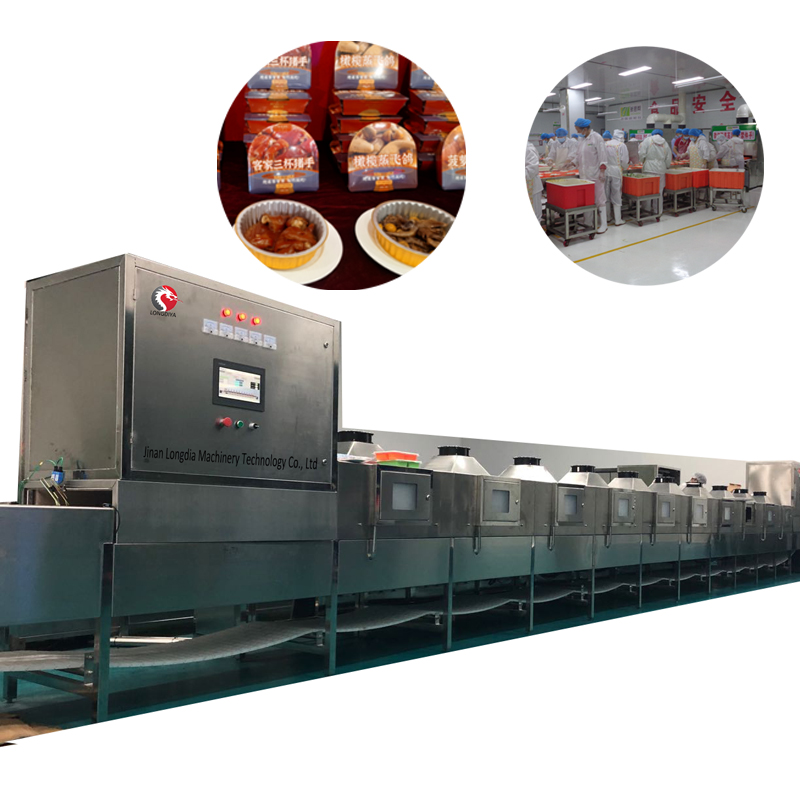
When you evaluate new equipment options, throughput versus footprint often drives the initial conversation. Continuous microwave tunnels boast a remarkably high power-to-space ratio. They process significantly higher volumes in a fraction of the space. Compare this compact footprint to standard spiral ovens or massive batch retort chambers. Processors can often double their line throughput without expanding their building.
Product quality improvements quickly justify the equipment transition. Rapid heating ensures excellent nutritional outcomes. Standard industry benchmarks show vastly improved vitamin retention, specifically for heat-sensitive vitamins like Vitamin C and B-complex. Shorter thermal exposure significantly reduces shear and texture breakdown. Your vegetables stay vibrant, and your meats remain tender, matching restaurant-quality expectations.
Energy consumption profiles shift dramatically during this upgrade. Processors abandon fossil-fuel-dependent steam boilers. You transition entirely to efficient electrical power. This shift creates a clear, measurable pathway to facility decarbonization. Upgrading your heating infrastructure directly reduces your Scope 1 carbon emissions, aligning perfectly with modern corporate ESG mandates.
Volumetric heating profoundly impacts microbial reduction and food safety compliance. You must prove lethality to FDA or USDA standards. Electromagnetic pasteurization requires rigorous multipoint thermal mapping. Proper mapping proves the geometric center consistently achieves the required temperature.
Best Practice: Always partner with recognized thermal processing authorities to validate your continuous line. They will help you establish critical control points (CCPs) for your hazard analysis and critical control points (HACCP) plan.
Implementing advanced electromagnetic technology carries inherent operational risks. The packaging constraint is often the biggest initial hurdle. Microwaves strictly require RF-transparent packaging materials. Metal foils or metallic-lined films will cause dangerous arcing and plasma generation. Non-compliant plastics often melt during the rapid heating cycle. You must audit your packaging supply chain immediately. Opt for robust materials like CPET (Crystallized Polyethylene Terephthalate) or specialized polypropylene blends.
Ingredient heterogeneity presents another unique engineering challenge. Uneven distribution of salt or moisture creates localized hot spots. Salt acts as a powerful catalyst for RF energy absorption. Some sections of a poorly mixed meal will cook much faster than others. You must adjust your formulations carefully. Recipe balancing is an absolute requirement prior to scaling up.
Industrial transmitters require significant utility and infrastructure upgrades. They need highly stable, three-phase electrical infrastructure. Voltage drops will directly impact your heating consistency. Furthermore, continuous generators demand specialized cooling systems. You will likely need to install robust water-cooled loops or heavy-duty air cooling systems to protect the magnetrons or solid-state amplifiers.
Finally, you must prioritize comprehensive operator training. You are shifting from simple mechanical thermal management to advanced electromagnetic process control. This transition requires serious upskilling. Your line operators and maintenance teams must understand RF energy dynamics safely. They need to learn how to troubleshoot complex power supply issues rather than just fixing leaky steam valves.
Common Mistake: Facilities often try to run legacy recipes through new microwave lines without adjusting the salt content. This always results in runaway heating at the edges of the tray. Reformulation is not optional; it is mandatory.
Finding the right equipment partner is a critical step. You cannot purchase this technology out of a catalog. Follow these specific steps to validate your purchase and ensure operational success.
Step 1: Dielectric Testing. Never purchase a system before testing your specific food matrix. Reputable vendors offer comprehensive lab-scale testing. They map exactly how your unique meals absorb RF energy. They measure the dielectric constant and loss factor of every ingredient. This data dictates the specific frequency and power level required for your machine.
Step 2: Pilot-Scale Validation. Run extensive pilot batches to validate the sensory outcomes. You must confirm the microbial kill steps thoroughly using inoculated pack studies. Stress-test your selected packaging integrity under real-world operational speeds. Ensure the trays do not deform when subjected to rapid volumetric expansion.
Step 3: Factory Acceptance Testing (FAT). Demand a comprehensive FAT from your vendor before the equipment ships. Require detailed thermal imaging reports proving uniform heat distribution. Ensure they provide full power leakage safety certifications. The machine must demonstrate strict compliance with OSHA regulations and FCC emission standards while running at maximum capacity.
Industrial microwave systems are not a simple plug-and-play magic bullet. They represent a calculated, highly engineered operational upgrade. When properly formulated and validated, they fundamentally resolve the severe throughput limitations of traditional manufacturing. They completely eliminate the dangerous quality compromises associated with conventional thermal systems.
Electromagnetic thermal processing is the logical next step for the industry. It perfectly serves facilities currently maxing out their physical floor space. It rescues food operations struggling to maintain consistent RTE meal quality at high volumes.
Take proactive action by scheduling a dielectric assessment today. Test your heaviest or most complex pre-made meal SKUs in a lab environment. Use this empirical data to build a baseline production efficiency model for your facility. Embracing volumetric heating now will position your operation ahead of the curve in a highly competitive market.
A: Yes, it can achieve full commercial sterilization. Microwave Assisted Thermal Sterilization (MATS) reaches shelf-stable lethality requirements. Atmospheric continuous systems typically focus on pasteurization for extended shelf-life refrigerated foods. Both processes require rigorous regulatory validation and multipoint thermal mapping to satisfy FDA or USDA food safety standards.
A: Electromagnetic energy interacts differently based on specific dielectric properties. Moisture and salt content dictate individual heating rates. A highly salted protein heats much faster than a dry starch. You must align your recipe formulations carefully. Balancing these properties ensures all compartments reach target temperatures simultaneously without edge-overheating.
A: Industrial continuous tunnels are incredibly safe. Manufacturers install specialized choke tunnels to contain the electromagnetic waves inside the chamber. Systems feature multi-point interlocking doors. They immediately shut off power if opened. Vendors ensure strict adherence to OSHA workplace regulations and international FCC emission standards during testing.
A: You can usually expect an ROI timeline between 18 and 36 months. Increased product yield and significantly reduced processing cycle times drive this rapid return. You also save heavily on labor and traditional boiler maintenance. These powerful operational efficiencies quickly offset your initial capital expenditure.